Country/region and language selection
Applications

Nanosecond micro welding: precision at speed

Pulsed laser light can be used to weld very thin metal sheets and foils, as well as many metal combinations. This can be done with very high precision, speed, and reliability. Find out more!

High-precision connections for complex components

In industrial manufacturing, manufacturers face the challenge of selecting the most efficient and precise methods for welding and joining materials. In pursuit of greater precision and innovative technological advancements, TRUMPF has developed a novel, patented welding technique known as nanosecond welding – also referred to as microwelding.

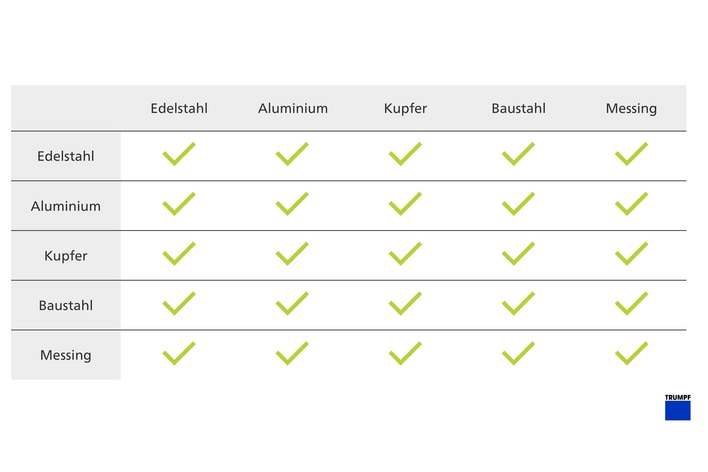
The nanosecond laser microwelding process entails the meticulous application of high-frequency laser light pulses, each lasting a few tens of nanoseconds (billionths of a second), to the parts being joined. With this controlled, minimal heat input, onlya small amount will melt for welding, thereby avoiding structural distortion and deformation of your parts. The TRUMPF nanosecond pulse laser system can weld a diverse range of metals. The process is especially suitable for reliably joining dissimilar metals.
Test the latest patented technology from TRUMPF now!

Nothing beats having your own experience! Test our patented pulsed fibre laser TruPulse nano with GTWave and PulseTune technology now for up to 30 days with no obligation — at your location, within your system!

Find out more Find out more

What are the advantages of pulse-laser microwelding?

Welding with nanosecond pulses has proven to be extremely beneficial in numerous industries. Here are some of the main reasons why it is so popular:

Precise control

Using pulses from a nanosecond laser, such as a pulsed fibre laser, extremely precise welds can be produced, even on micro-welded components.

Low heat effects and minimal melt

The short laser pulses generate minimal heat, minimizing the risk of material deformation or cracks. The low melt level significantly decreases the formation of brittle intermetallics when joining dissimilar metals.

Versatility in materials and geometry

Nanosecond welding is suitable for a wide range of metals, particularly for joining dissimilar metal combinations that were considered unweldable with conventional welding processes. Laser pulses can be flexibly arranged and controlled, allowing for versatile geometries. 

Efficiency and repeatability

The low energy consumption and the minimal melt content enable efficient joining and processing.

What is nanosecond welding, and how does it work?

Nanosecond technology is based on very short laser pulses with pulse durations in the nanosecond range. A single laser pulse only penetrates a few micrometres into the material. This is why multiple pulses with high repetition frequencies are required, which effectively penetrate into the material, generating very focused, localised heating which ultimately creates a micro keyholethat gives a deep high aspect ratio weld.

Only a small amount of melt is formed, ensuring that the welded materials mix minimally. This results in an inhomogeneous weld zone and a robust mechanical connection, This is particularly important for welding dissimilar materials that are typically difficult to join. Pulse shape and pulse frequency can be optimised to precisely control the penetration depth and the size of the melt pool . This makes it also possible to perform greater welding depths with a small diameter. 

White paper

PDF - 909 KB
Would you like to find out more about the potential of nanosecond welding? Download our white paper today!
The pulsed fibre lasers of the TruPulse nano series from TRUMPF offer an innovative approach  to tough industrial joining challenges. Find out how to connect thin sheets or foils or join dissimilar metal combinations with the TRUMPF TruPulse nano.

What is nanosecond welding suitable for?

Materials

Nanosecond welding is suitable for a wide range of metals. It is also feasible to join dissimilar metal combinations that have been considered difficult to join by conventional welding processes. This makes the nanosecond microwelding process ideal for many different industries, ranging from electronics manufacturing to medical technology.


Metals

  • Steel (including carbon steel, stainless steel, and alloy steel)
  • Aluminium
  • Copper
  • Brass
  • Titanium
  • Nickel and nickel alloys
  • Zinc

Sensitive materials or components

  • Films and sheets
  • Batteries
Material thickness

The thickness of the materials used in nanosecond welding typically ranges from 0.05 to 1 mm. It is also possible to join larger material thicknesses using higher laser powers, depending on the material.

Weld joint requirements

Nanosecond welding uses a scanner-controlled laser beam guidance, which ensures the greatest possible flexibility during joining. Depending on the scanner selected, different weld seam geometries can be achieved. This is particularly useful for overlapping connections , which is the most common application of nanosecond laser welding.

Application areas for nanosecond pulsed laser welding

Electrical contacts in the electrical industry

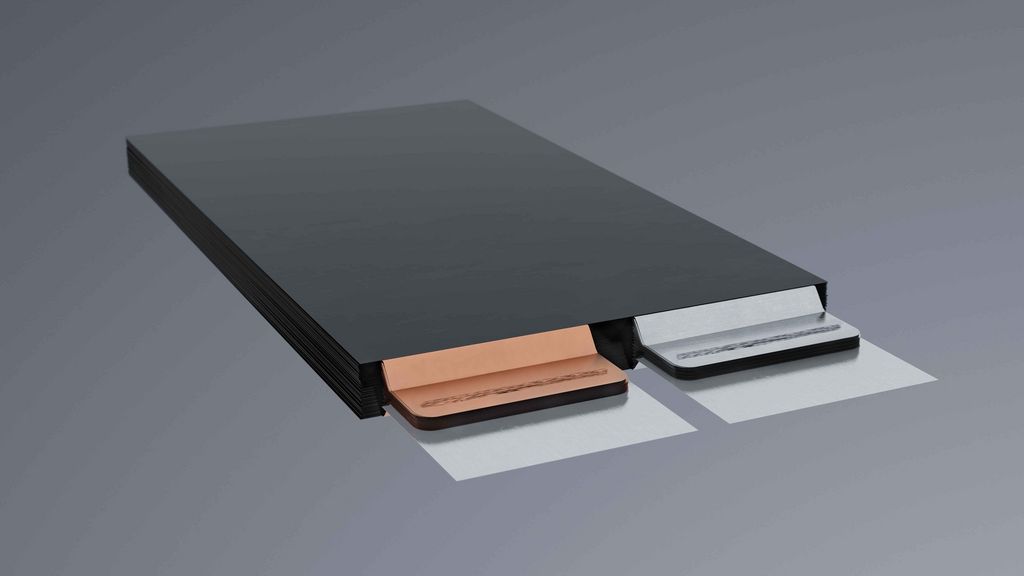
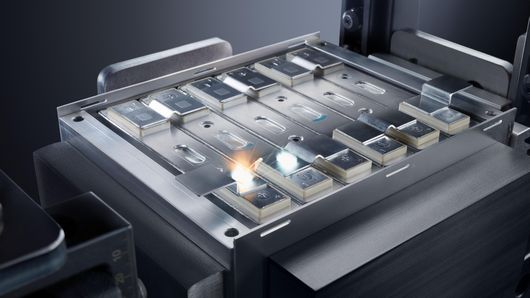
An important application for nanosecond welding is the assembly of standard battery cells into larger packages for all types of power tools, vacuum cleaners, e-bikes and e-vehicles. Contacts for flexible circuit boards such as connector connections are also produced in the consumer electronics industry.

Intermetallic joints in battery production for the automotive industry

In the automotive industry, nano pulse micro welding plays a significant role in joining, for example in battery production. For example, this is where cylindrical cells made of nickel-coated steel are contacted. Our lasers allow one-sided access to the work material, which makes processing easier.

Test the latest patented technology from TRUMPF now!

Nothing beats having your own experience! Test our patented pulsed fibre laser TruPulse nano with GTWave and PulseTune technology now for up to 30 days with no obligation — at your location, within your system!

Find out more Find out more

Nanosecond welding in action

Mike Poulter, our nanosecond welding expert, explains the advantages and potential of this technology.

We have the right lasers and laser systems for nanosecond welding

TruPulse nano

The TruPulse nano range provides numerous options for enhancing both productivity and quality. With an average power as low as 70 W, welding tasks involving thin sheet metal can be accomplished. TruPulse nano lasers are modules for integration, and as such, they are commonly employed with third party scanner optics and the associated control hardware and software.

TruMark 5000

The fibre-laser-powered TruMark Series 5000 wows with its perfect blend of high power, high pulse frequencies and adjustable pulse duration. The TruMark series features a TruPulse nano laser at its core, capable of addressing all applications, including nanosecond welding.

TruMark 7050

More power, more speed, more flexibility, and more applicability! The TruMark 7050 is a multifunctional tool that is easy to use and integrate. It is a turnkey solution that is easy to use.

You may also find these topics interesting

Laser welding with TRUMPF lasers
Laser welding

Lasers facilitate precise, controlled welding with minimal heat input – from tiny weld points in the millimetre range to high-precision, meter-long weld seams. Discover more about the benefits and capabilities of laser welding!

Laser options for battery cells and modules

Find out more about the options for using lasers to manufacture lithium-ion batteries for the automotive industry. We'll show you how laser technology overcomes the key challenges facing the industry, from high gravimetric energy density to safety and longevity.

E-mobility made with TRUMPF Laser
E-mobility made with TRUMPF lasers

Creating the future today. Discover how you can shape the mobility of the future with our manufacturing solutions.

Contact